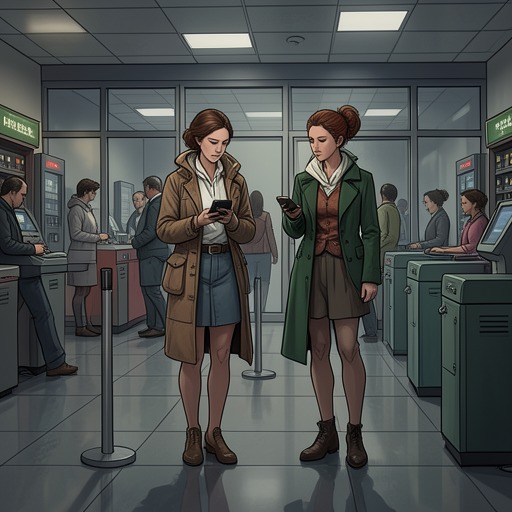
Natasha’s thank-you message helps save Irene’s life
The Sun is Also a StarNatasha Kingsley’s thank-you message to Irene, a security guard at the United States Citizenship and Immigration Services building in New York City, becomes an unknowing intervention in a suicide crisis. Natasha makes the call because she sees the day’s chain of encounters as beginning with Irene’s delay; Irene receives it without knowing what prompted the gratitude, but at the moment she most needs evidence that someone has noticed her. The message connects an apparently incidental inconvenience to a life-changing consequence, and turns Natasha’s impulse to acknowledge a stranger into the start of Irene’s survival.
The delay and the chain of encounters
Earlier that day, Irene’s inspection of Natasha’s belongings delayed her. Natasha later reconstructs the consequences as a sequence: without the delay, there would have been no Lester Barnes, no Attorney Fitzgerald, and no Daniel Jae Ho Bae. The thought gives a minor obstruction an unexpected weight. Natasha does not treat the delay as an injury to settle; instead, she sees it as the first link in a day that brought her to Daniel. Her thanks are therefore directed not only toward a guard who handled her belongings, but toward the improbable chain of meetings that followed.
The call comes while Natasha and Daniel are close together. Daniel has drawn her toward him, and Natasha has pulled the tie from his hair and run her fingers through it. When he leans in to kiss her, she stops him and asks him to hold the kiss. The pause is brief but consequential: an impulse interrupts their intimacy because Natasha suddenly wants to acknowledge someone else. She recognizes that the day has made her almost believe in being meant for another person, and decides that the guard who delayed her should hear her gratitude.
Natasha searches her backpack for Lester Barnes’s business card and calls him. The call goes to voicemail. She leaves a rambling message thanking Barnes for his help and asking him to pass her thanks on to the security guard. The message is an indirect one: Natasha cannot speak to Irene herself, and relies on Barnes to carry the words back to her. She describes Irene as the guard with long brown hair and sad eyes who touches everyone’s belongings, then, just before hanging up, remembers Irene’s name. Daniel looks puzzled by the interruption. Natasha tells him she will explain later, returns to his arms, and suggests going back to the norebang.
A message received at the edge of crisis
The later account reveals the peril hidden from Natasha when she made the call. Irene was still working as a security guard at the United States Citizenship and Immigration Services building when Barnes stopped at her station and told her that a girl had left a thank-you message for her. Irene never learned what the gratitude referred to. She did, however, receive the message on the day she had planned to commit suicide.
By then, Irene had written a suicide note during lunch and mentally plotted her route to the roof of her apartment building. The novel sets those preparations against the simplicity of what reaches her: a stranger has made the effort to call and say thank you. Natasha does not know that Irene is in danger, and the message contains no explicit offer of help. Its force comes from the fact that it tells Irene that someone saw her. The event’s turn is from a private plan for death toward a small, unexpected experience of recognition—not an instant cure, but a reason to take another step.
That night, Irene listens again to a Nirvana album. In Kurt Cobain’s voice she hears misery and loneliness alongside a joy that persists without breaking; the music offers a way to encounter despair that is not simply silent or solitary. She also thinks about Natasha’s effort to leave a message for her. The gesture shifts something inside her, though the narration is careful to distinguish a shift from a recovery. Irene calls a suicide prevention hotline. The hotline leads to therapy, and therapy leads to medication that, in the account of her later life, continues to save her.
Long consequences and changed direction
Two years after the message, Irene leaves her job at the United States Citizenship and Immigration Services building. She recalls a childhood dream of becoming a flight attendant and makes that dream her work. Her life is described as simple and happy, lived on planes; the change is not presented as the message alone solving her crisis, but as part of a longer passage through crisis care and into a new life. The call to a hotline, therapy, and medication remain essential links between the moment of recognition and the life that follows.
Irene carries her knowledge of loneliness into her work. Aware that planes can intensify isolation and that loneliness can become desperate, she pays particular attention to passengers who may need help. She comforts people flying alone to funerals and holds the hands of passengers with acrophobia or agoraphobia. She thinks of herself as a guardian angel with metallic wings. That self-image extends the story’s chain of care: once reached by an unseen stranger’s modest act, Irene becomes attentive to other people whose distress might otherwise go unnoticed.
Narrative significance
The event’s meaning depends on a sharp difference in knowledge. At the time of the call, Natasha believes she is thanking Irene for her part in a fortunate chain of encounters; she has no knowledge of Irene’s suicide note or plan. Irene, in turn, does not know what Natasha is thanking her for, but the fact that a particular person took the trouble to reach her matters. The two women’s understandings do not match, yet the message has force precisely because it crosses that gap without either woman anticipating its effect.
The delayed revelation also changes how the earlier scene reads. Natasha’s impulse initially seems like a small coda to a romantic moment with Daniel Jae Ho Bae. The later account gives that interruption a second consequence: the pause that sends Natasha back to Lester Barnes’s voicemail becomes part of the reason Irene lives. The novel thus makes coincidence neither a guarantee of destiny nor an empty accident. A delay can redirect a day, but its significance emerges through what people do next—in this case, Natasha’s decision to say thank you, and Irene’s decision to seek help. The message cannot heal Irene by itself; it gives her, at a critical moment, evidence that she has been seen and a bridge toward sustained care.